The BRICS group is a group of five countries with emerging economies that want to instate their own world economic and trade systems and has discussed creating a new currency. The group consists of Brazil, Russia, India, China, and South Africa. The acronym was originally BRIC, but South Africa joined the group in 2010. The group was founded in 2006 as an informal alliance that contributes to the world economy. Since 2009, the group has held annual summits and coordinated multilateral policies. The group has also created its own financial institutions, such as the New Development Bank and the BRICS Contingent Reserve Arrangement. The group aims to reduce the reliance on the U.S. dollar and promote the use of national currencies in international trade. The group has also sought to expand its membership, inviting six more countries to join in 2023.
In this blog post, we will explore what the BRICS group is, who are the members, what are their achievements and challenges, and why it matters for the global economy and governance.
What is the BRICS group?
.The term BRIC was coined by Goldman Sachs economist Jim O’Neill in 2001 as an acronym for four countries that he predicted would become the dominant economic forces by 2050. He argued that these countries had large populations, fast-growing economies, abundant natural resources, and potential for innovation. He also suggested that these countries could form a powerful bloc that could challenge the dominance of the developed countries in the global arena.
In 2006, the foreign ministers of Brazil, Russia, India and China met for the first time in New York to discuss their common interests and cooperation. They agreed to hold regular meetings and dialogues to enhance their coordination on various issues. In 2009, they held their first summit in Yekaterinburg, Russia. They issued a joint statement that called for a more democratic and multipolar world order based on mutual respect and cooperation. They also expressed their support for reforming the international financial institutions to reflect the changing realities of the world economy.
In 2010, South Africa was invited to join the group at the request of China. The group became known as BRICS and held its first summit with South Africa in Sanya, China. The group welcomed South Africa as a valuable partner that could represent the interests of Africa and enhance the diversity of the group.
Since then, the BRICS group has held annual summits and established various mechanisms for cooperation in various fields such as trade, finance, health, education, science and technology, culture, security, and environment. The group has also created its own financial institutions, such as the New Development Bank and the BRICS Contingent Reserve Arrangement. The group aims to reduce the reliance on the U.S. dollar and promote the use of national currencies in international trade.
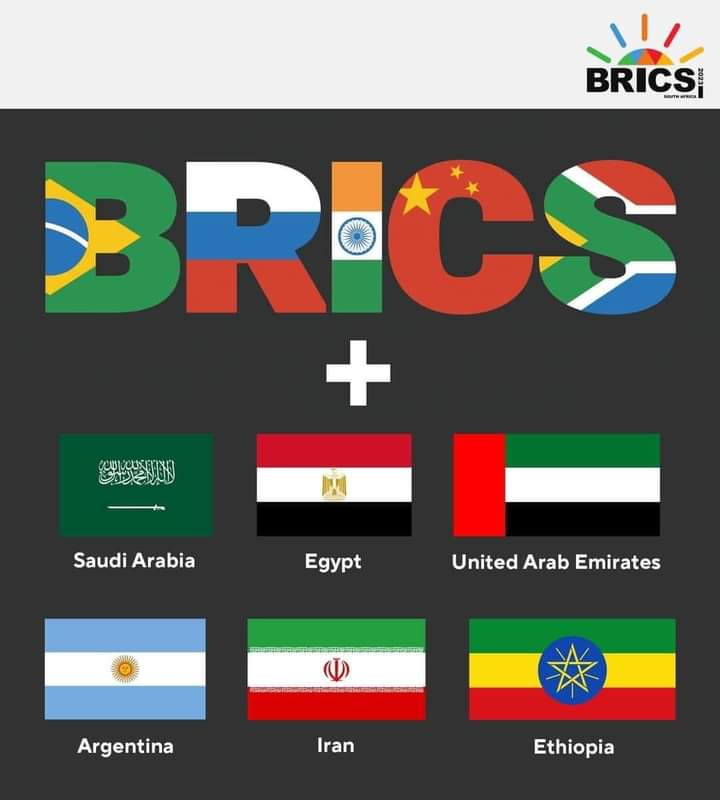
In 2023, BRICS announced a major expansion by inviting six more countries to join the bloc: Argentina, Egypt, Ethiopia, Iran, Saudi Arabia, and the United Arab Emirates.
Who are the members of the BRICS group?
The members of the BRICS group are Brazil, Russia, India, China, and South Africa. These five countries have some common characteristics as well as some differences.
Brazil is the largest country in South America and has a population of about 213 million people. It has a GDP of about $1.4 trillion and is ranked as the ninth-largest economy in the world. It is also one of the most biodiverse countries in the world and has abundant natural resources such as oil, gas, iron ore, and soybeans. Brazil is a democracy with a federal presidential system and a multi-party system. It is also a regional leader and an active participant in various international organizations such as the United Nations, the Organization of American States, and the Community of Portuguese Language Countries.
Russia is the largest country in the world by area and has a population of about 146 million people. It has a GDP of about $1.7 trillion and is ranked as the eleventh-largest economy in the world. It is also a nuclear power and a permanent member of the UN Security Council. Russia has vast natural resources such as oil, gas, coal, and metals. Russia is a federation with a semi-presidential system and a dominant-party system. It is also a global player and a key partner in various regional organizations such as the Commonwealth of Independent States, the Eurasian Economic Union, and the Shanghai Cooperation Organization.
India is the second-most populous country in the world and has a population of about 1.4 billion people. It has a GDP of about $2.9 trillion and is ranked as the fifth-largest economy in the world. It is also one of the fastest-growing economies in the world and has a large and diverse workforce. India has rich cultural and historical heritage and is home to many religions and languages. India is a democracy with a parliamentary system and a multi-party system. It is also a regional leader and an influential actor in various international organizations such as the Non-Aligned Movement, the Commonwealth of Nations, and the South Asian Association for Regional Cooperation.
China is the most populous country in the world and has a population of about 1.4 billion people. It has a GDP of about $14.7 trillion and is ranked as the second-largest economy in the world. It is also the largest exporter and importer of goods in the world and has a huge domestic market. China has a long and rich history and culture and is one of the oldest civilizations in the world. China is a one-party socialist state with a centralized system of governance. It is also a global power and a major partner in various regional organizations such as the Association of Southeast Asian Nations, the Asia-Pacific Economic Cooperation, and the Forum on China-Africa Cooperation.
South Africa is the southernmost country in Africa and has a population of about 60 million people. It has a GDP of about $283 billion and is ranked as the thirty-fifth-largest economy in the world. It is also one of the most diverse countries in the world and has 11 official languages. South Africa has abundant natural resources such as gold, diamonds, platinum, and coal. South Africa is a democracy with a parliamentary system and a multi-party system. It is also an African leader and an active participant in various international organizations such as the African Union, the Southern African Development Community, and the New Partnership for Africa’s Development.
If you want to learn more about the BRICS group, you can check out these links:
- What are the achievements and challenges of the BRICS group?
- What is the role of BRICS in global governance?
Discover more from Haqiqa Global Business
Subscribe to get the latest posts sent to your email.
 Haqiqa Global Business
3 Replies to “BRICS Group: What is the BRICS group, Who are the members of the BRICS group, and What are the achievements and challenges of the BRICS group?”